Overview The Everest Base Camp Trek is Nepal’s most famous and jaw dropping adventure. It takes you on foot to the base of the world’s tallest mountain “Everest”. Through Sherpa […]
Duration: 14 Days
Best Time:
Trip Grade: moderate_strenuous
Start from Kathmandu and End to Kathmandu
Min 2 to Max 10 Pax in a group
Meals: Breakfast, Launch & Dinner
Accommodation: Tea House
Overview
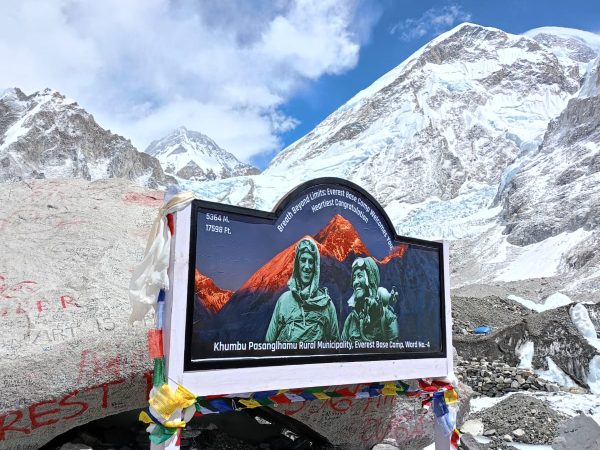
The Everest Base Camp Trek is Nepal’s most famous and jaw dropping adventure. It takes you on foot to the base of the world’s tallest mountain “Everest”. Through Sherpa villages, pine forests, and high mountain villages, ending at 5,364 meters where the Khumbu Icefall meets the sky.
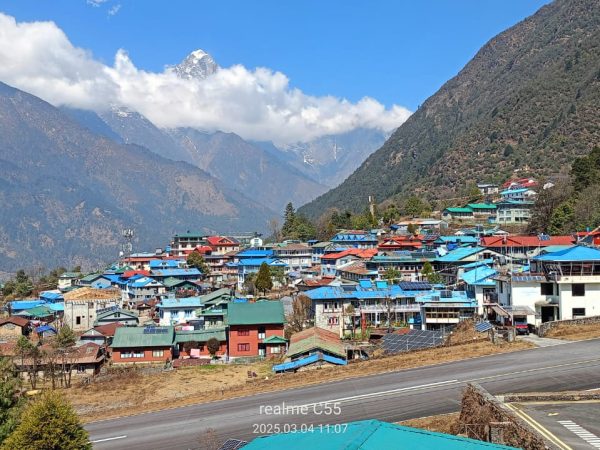
For almost every trekker, the trip starts the same way. A small plane drops down toward Lukla, and the runway appears out of nowhere, a short strip of concrete glued onto the side of a mountain with nothing but open air at either end. It’s less of a landing and more of a dare. From there, the trail climbs steadily for 12 to 14 days, following the Dudh Kosi river valley up through the Khumbu region toward Everest.
Here’s something worth knowing before anything else: the Everest Base Camp Trek is not a technical climb. There are no ropes, no ice axes, no mountaineering permits. It’s simply a long walk at high altitude, and the thing that makes it hard isn’t the ground under your feet, it’s the air above it. That’s exactly why thousands of regular people, not professional climbers, reach base camp every single year.
This guide covers everything a first-time trekker actually needs to know: the day-by-day itinerary, permit costs, altitude sickness, gear, guide and porter services, and an honest answer to whether beginners can really do this trek.
Highlights of Everest Base Camp Trek
Namche Bazaar: the unofficial capital of the Khumbu, built into a bowl-shaped hillside with bakeries, gear shops, and your first clear view of Everest from the trail above town.
Tengboche Monastery: sitting on a ridge with Ama Dablam rising behind it, one of the most photographed spots on the entire route.
Kala Patthar: a rocky viewpoint above Gorak Shep that gives the best unblocked view of Everest’s on the whole trek, better than base camp itself.
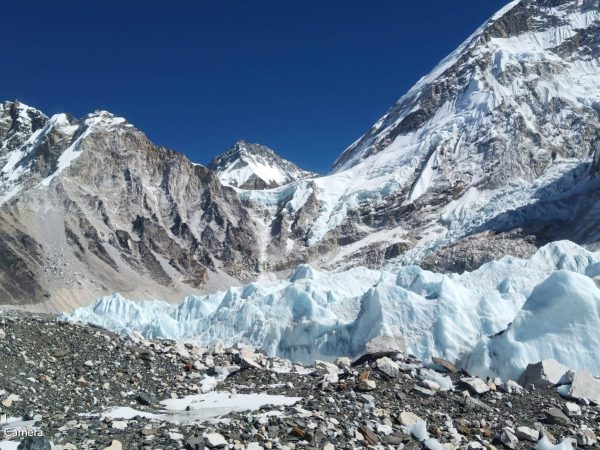
Everest Base Camp: which turns into a small tent city during climbing season, full of climbers preparing for their summit push.
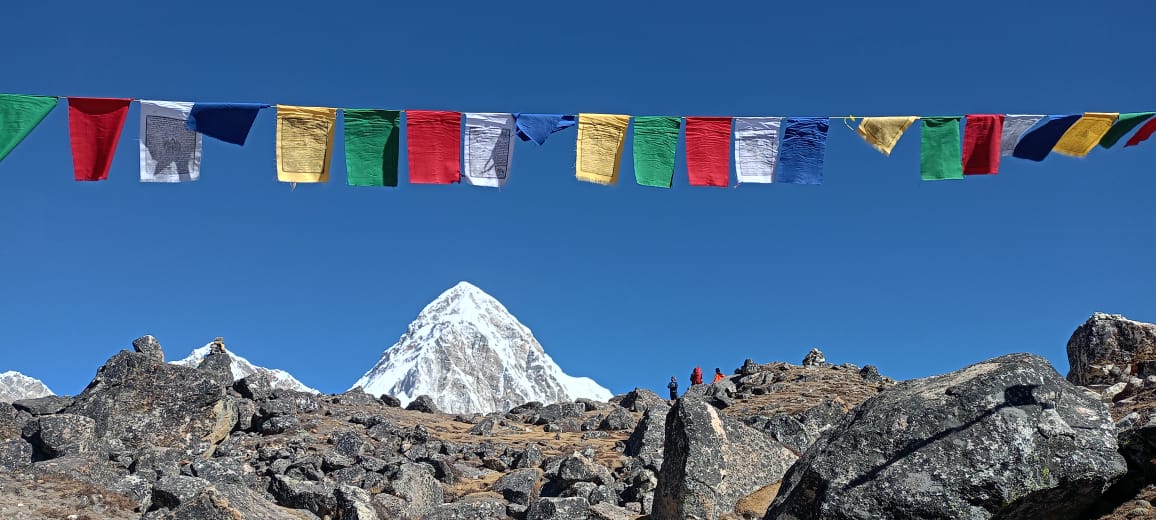
Sherpa culture: present in every teahouse meal, monastery bell, and prayer flag along the way, older and steadier than the trekking industry built around it.
Best Season for Everest Base Camp Trek
Two windows work best for the Everest Base Camp Trek: pre-monsoon spring, from March to May, and post-monsoon autumn, from late September to November.
Autumn: Autumn (sep-nov) usually brings the clearest skies and the most stable weather right after the monsoon rains clear the dust out of the air, which is exactly why it’s the busiest season on the trail.
Spring: Spring (march-may) runs a close second, with warmer daytime temperatures and rhododendron forests in full bloom lower down the valley, though afternoon cloud cover builds more often than in autumn.
Winter: From December to February, is possible and has become more popular with trekkers chasing empty trails and dramatically clear mountain views, but nights at higher camps drop well below freezing, sometimes to minus 15 degrees Celsius or colder, and some teahouses shut down entirely.
Monsoon season: June through August, is the one stretch worth avoiding altogether: heavy rain, leeches at lower altitudes, clouded-in views, and a real risk of Lukla flight cancellations. But the greenery during this season is mesmerizing. Though the views rarely open up, but it might be best ones.
Difficulty
The Everest Base Camp Trek difficulty rates as moderately difficult: technically simple, but physically and mentally demanding in a way that surprises a lot of first-timers. There’s no climbing involved and no exposed scrambling on the standard route, nothing that requires specialized mountaineering skill. What actually makes it hard is the accumulation, long walking days, steep ascents and descents through the lower valley, and steadily thinning air above 3,500 meters, where oxygen levels drop to roughly half of sea level.
Most days involve four to eight hours of walking, shorter at the start and longer as the trail approaches Gorak Shep and base camp. The path itself is well-maintained and clearly marked, following stone trails and suspension bridges that see heavy foot traffic throughout the season. It’s the altitude, not the ground beneath your feet, that turns a fairly ordinary walk into something demanding real respect. Fit trekkers still struggle if they climb too fast, while others with more modest fitness levels succeed simply by pacing themselves and sticking to the acclimatization schedule. Many trekkers describe the experience as roughly 70 percent mental and 30 percent physical, since exhaustion, repetitive days, and thin air test willpower just as much as muscles. It’s also common to lose 7 to 10 percent of body weight over the two weeks, mostly from reduced appetite at altitude combined with the physical effort of the walk.
Can Beginners Do The Everest Base Camp Trek?
Yes, You don’t need mountaineering experience or elite athletic ability to complete the Everest Base Camp Trek. What you actually need is a reasonable base of cardiovascular fitness, the patience to walk slowly, and a genuine willingness to take altitude seriously.
Guides on this trail have led people in their sixties alongside teenagers doing their first big trip abroad. The trek tends to succeed or fail based on pacing, not raw athletic ability. Rushing is what breaks beginners, not the walking itself. If you can comfortably hike five to seven hours a day on back-to-back days while carrying a light daypack, you already have the physical base this trek requires. The rest comes down to preparation: a few months of cardio and stair-climbing beforehand, and an itinerary built with proper acclimatization days rather than a compressed schedule designed to save one night’s lodging cost.
Success rates for well-prepared trekkers on properly paced itineraries typically fall between 80 and 95 percent, and most people who don’t make it turn back because of altitude sickness caused by rushing, not because of poor fitness.
Food during EBC Trek
Food on the Everest Base Camp trek is simple but don’t worry you will eat well. The most common meal is dal bhat, which is rice, lentil soup and vegetable curry. Most trekkers end up eating it almost every day because it provides good energy and free refills till you are full. Along with that you will find local Sherpa food like Thenthuk, Rildok, Tibetan bread, and simple soups. If you want something familiar, teahouses also serve pasta, pizza, sandwiches, porridge and pancakes. Pizza is actually common in places like Namche Bazaar. Meat becomes less common and less safe to eat as you go higher. The Sherpa people follow Buddhist belief and do not kill animals, so meat has to be carried up all the way from Kathmandu, usually flown in and then carried by porters or yaks, so it is not always fresh. Because of this most guides tell trekkers to stick with vegetarian food once they go higher up, since it sits better in the stomach. Tea is something you will drink a lot of to stay warm, and water should always be boiled or treated before drinking. Prices go up the higher you climb since everything has to be carried in by hand or by animal. A basic breakfast can cost around 7 to 12 dollars lower down, while pizza or pasta can go up to 15 dollars near the top.
Accommodation on Trek
For sleeping, you stay in teahouses, which are small family run guesthouses along the trail. Rooms are basic, usually two beds with thick blankets, and bathrooms are shared. In lower villages like Lukla and Namche Bazaar, teahouses are a bit more comfortable, sometimes with private rooms and hot showers. As you go higher, toward places like Dingboche, Lobuche and Gorak Shep, things get much more basic. Gorak Shep especially is known for being cold, and most trekkers do not sleep well there because of the altitude. Every evening people gather in one shared dining room, usually heated by a stove, and this is where most of the trek’s social life happens. Things like hot showers, Wi-Fi and charging your phone usually cost extra, and the price rises the higher you go.
Culture
The sherpa culture is what you will experience in the trek. You are walking through Sherpa land, and Buddhist tradition shows up everywhere. From prayer flags on the ridgelines, prayer wheels spinning at village entrances, stone walls carved with mantras, and monasteries like the one in Tengboche. Teahouses are not just a place to sleep, they become a place where trekkers and Sherpa families sit together, talk and share a meal. In the evenings people often play cards or listen to music, and guides sometimes teach trekkers local games.
Food ties into culture too, a sweet fried rice doughnut called sel roti often shows up during the Dashain festival, and a fermented millet drink called tongba is sometimes shared after a hard day of climbing. Small things like saying Namaste, walking clockwise around stone walls and stupas, and asking before taking photos of people or monasteries matter a lot to locals. By the end of the trek, people remember it as much for the dal bhat, the stone lodges and the Sherpa hospitality as they do for the mountain itself.
Altitude Sickness Prevention
Altitude, is what actually what we have to be concerned about this trek. Base camp sits at 5,364 meters, and Kala Patthar goes even higher to 5545m , well into territory where oxygen levels drop to roughly half of what they are at sea level. Acute mountain sickness shows up as headache, nausea, dizziness, and fatigue that doesn’t match the day’s effort. Left ignored, it can turn into something far more dangerous.
A few preventive measures to keep it in check:
Climb slowly: The general rule is to avoid increasing sleeping altitude by more than 300 to 500 meters a day above 3,000 meters, with a rest day built in roughly every 1,000 meters.
Sleep low, climb high: whenever possible, day accent to a higher point followed by a descent to sleep lower down.
Hydrate constantly: Thin air dehydrates the body faster than most people expect.
Avoid alcohol and sleeping pills: at altitude both suppress breathing so be mindful about this.
Listen to your guide and your own body: If symptoms get worse at rest, descending is the only real treatment, and no view is worth ignoring that warning sign.
Namche Bazaar (3,440m) and Dingboche (4,410m) are the two standard acclimatization stops built into the itinerary above, and skipping either one to shave off a day remains one of the most common and most preventable mistakes on this trek.
Travel Insurance Requirements
Don’t treat travel insurance as optional paperwork for this trek. Everest Base Camp trek insurance needs to cover two specific things: high-altitude trekking up to at least 6,000 meters, and helicopter evacuation. Ordinary travel insurance policies frequently exclude both, and that gap usually only becomes obvious the moment someone actually needs a rescue. Helicopter evacuations from the Khumbu region aren’t cheap, and in the past, some providers along the trail have arranged them before confirming a trekker’s coverage, leaving people with bills running into the thousands of dollars. A proper policy removes that risk completely. When buying insurance, check the altitude limit stated clearly in the policy document itself, not just the marketing page, and keep the policy number saved on your phone as well as on paper.
Drinking Water on the Trek
Staying hydrated matters just as much as any acclimatization strategy on the Everest Base Camp trek, and how you get your water matters too. Bottled water is sold at every teahouse along the route, but prices climb with the altitude, and plastic waste has become a genuine environmental problem in this fragile mountain ecosystem.
Most experienced trekkers instead carry a reusable bottle or bladder and treat water from taps, streams, or teahouse jugs using purification tablets, a UV pen, or a filter. Several lodges along the main route now sell boiled or filtered water refills at a lower price than bottled water, so it’s always worth asking. Whatever method you choose, plan on drinking three to four liters a day, more on longer or higher days, since altitude speeds up fluid loss even when you don’t feel like you’re sweating.
Everest Base Camp Trek Elevation
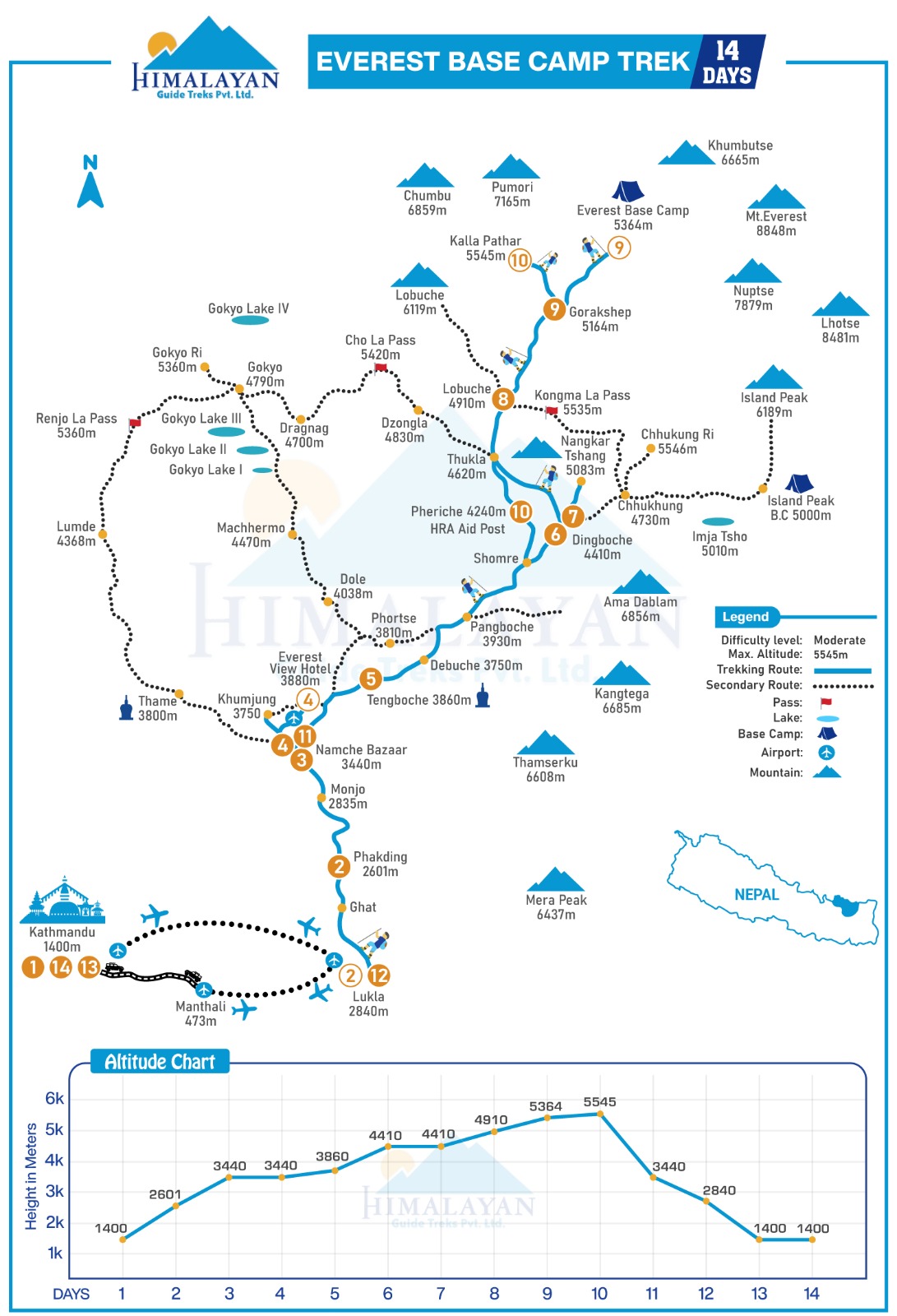
The elevation gain, laid out day by day in the itinerary above, is really the heart of why this trek is hard. From Lukla’s airstrip at 2,840 meters to Everest Base Camp at 5,364 meters. That’s a climb of roughly 2,500 meters spread across a week and a half of walking, with two built-in acclimatization stops along the way. Kala Patthar, the trek’s true high point, tops out at 5,545 meters. Daytime temperatures on the trail generally range from about 5 to 15 degrees Celsius, dropping well below freezing at night once you’re above 4,000 meters, sometimes down to minus 15 or even minus 20 degrees Celsius at the highest camps. The elevation numbers alone explain why altitude sickness prevention gets so much attention in every serious guide to this route, this one included.
Everest Base Camp Trek Permits
Every trekker heading into the Khumbu region needs two permits, both tied to the area’s status as protected land and community-managed municipality.
Sagarmatha National Park Entry Permit: required because the trail passes through Nepal’s first UNESCO-listed national park, home to snow leopards, red pandas, and the Himalayan tahr. This permit is best arranged in Kathmandu before flying to Lukla, though it can also be picked up at the park entrance in Monjo.
Khumbu Pasang Lhamu Rural Municipality Entry Permit: a local fee charged by the rural municipality the trail passes through, usually obtained in Lukla or Monjo.
Bring your passport, a handful of passport-sized photos, and some cash for the permit offices, since card payment isn’t reliably available at either checkpoint.
Guide and Porter Services on Everest Base Camp Trek
Hiring a guide isn’t just a comfort purchase on this trek. It’s often the difference between a trip that runs smoothly and one that unravels the moment something goes wrong. A licensed guide reads altitude symptoms early, manages daily pacing, handles permit logistics, and knows which teahouse actually has hot water tonight and which one is only saying so.
Porters carry the bulk of your luggage, usually up to around 15 kilograms per trekker, freeing you to walk with just a light daypack. This alone makes a real difference in how your body copes with altitude gain each day, since carrying less weight means burning less energy at elevations where oxygen is already scarce.
Guide costs in 2026 generally run between 35 and 50 US dollars a day, with porters coming in a bit lower, and most reputable packages bundle both into an all-inclusive price alongside teahouse lodging, meals, and Lukla flights. Trekkers going independent to save money should consider at minimum a porter-guide, a hybrid role common in the Khumbu that combines both jobs at a lower combined cost than hiring separately. Whichever option you pick, always confirm your guide is licensed and your porter is properly insured, since unsafe load limits and uninsured labor remain a real problem in parts of Nepal’s trekking industry.
Explore More Routes In Everest Base Camp
The classic Lukla-to-base-camp trail is the most walked route in the Khumbu, but it’s far from the only one.
Gokyo Lakes and Cho La Pass adds a detour through a string of turquoise glacial lakes and a high mountain pass, connecting back to the main base camp trail, ideal for trekkers wanting fewer crowds and wider scenery.
Three Passes Trek links Renjo La, Cho La, and Kongma La in one demanding loop, a serious step up in difficulty best suited to experienced high-altitude trekkers.
Jiri to Everest Base Camp follows the original overland route used before Lukla’s airstrip existed, adding roughly a week of walking through lower, quieter villages before joining the standard trail.
Everest View Trek, a shorter, lower-altitude option for travelers short on time or wary of extreme altitude, reaching Namche Bazaar and Tengboche without continuing on to base camp.
Each of these routes shares infrastructure with the main trail, so it’s entirely possible to combine one detour with your base camp itinerary without adding much complexity to your permits or planning.
Everest Base Camp Trek Cost
Pricing on this trek varies more than most people expect, and the gap usually comes down to how much is bundled into the quoted price.
Independent trekking, arranging your own permits, flights, food, and lodging without a guide or porter, typically costs 25 US dollars for the full trip. It’s the cheapest option, though it comes with more logistical risk and less of a safety net if altitude symptoms or weather delays complicate your plans.
Standard guided packages, the choice most first-timers land on, bundle a licensed guide, porter, teahouse accommodation, most meals, permits, and Lukla flights into one price, generally landing between 1,400 and 2,500 US dollars for a 12 to 14 day trip. Luxury treks, with smaller groups, senior guides, upgraded lodges, and sometimes a helicopter return from Gorak Shep, run from around 3,000 US dollars up past 5,000, depending on how much comfort you’re buying back into the trail.
On top of whichever package price you settle on, budget separately for travel insurance, a Nepal visa (30 to 125 US dollars depending on how long you stay), personal gear, extra snacks and drinks on the trail, tips for your guide and porter, and a buffer for Lukla flight delays, which happen often enough during peak season to plan around rather than hope against.
Why Choose Everest Base Camp Trek?
There are dozens of trekking routes across Nepal, so it’s fair to ask why this particular trek keeps drawing people back year after year, decade after decade.
Part of it is simply the mountain itself. Standing within sight of the highest point on Earth changes how you see scale in a way photographs never quite manage. But this trek offers more than one big view. It’s twelve days of Sherpa villages, monastery bells, yak trains crossing narrow bridges, and a culture built around these mountains long before trekking tourism ever existed. It’s also a physical challenge that’s genuinely accessible to ordinary, reasonably fit people, not just elite athletes, which makes reaching base camp feel earned rather than exclusive.
And it’s a well-supported trail. Teahouses, guides, porters, altitude clinics, and rescue infrastructure exist at every stage, built up over decades of foot traffic, so first-timers aren’t heading into true wilderness unprepared. For anyone weighing where to spend two to three weeks of hard-earned vacation time, Everest Base Camp remains, for good reason, at the very top of that list.
Itinerary
If you want tailor-made trip or want to personalize this itinerary, just feel free to contact us. We are always there to help you to make your holiday plan. Contact us
Day 1
Arrival in Kathmandu
Your trek officially begins the moment you land in Kathmandu. Our representative will welcome you at the airport and drop you at your hotel.You can spend the day settling into their hotel, exchanging money in Thamel, and picking up any last-minute gear. This is also when guides usually do a final equipment check and go over the trek plan, so it's worth keeping the evening free for a briefing. Get an early night here, because the next morning starts before sunrise
Day 2
Fly to Lukla (2,840m/9,318ft) and trek to Phakding (2,601m/8,563ft)
Flights to Lukla leave early, usually before 7am, since mountain weather turns unpredictable by mid-morning. The flight itself takes around 30 to 35 minutes and is famous for being short, scenic, and a little nerve-wracking, landing on one of the world's most dramatic airstrips. From Lukla, the trek begins with a gentle three-hour walk down to Phakding along the Dudh Kosi river, a good warm-up day that eases you into the rhythm of trail life without much elevation gain.
Day 3
Trek from Phakding to Namche Bazaar (3,440m/11,286ft)
This is where the trek starts to feel real. The trail crosses several suspension bridges, including the famous Hillary Suspension Bridge, before a long, steady climb into Namche Bazaar. Expect around 5 to 6 hours of walking, with the final stretch into Namche being the steepest part of the day. This is often the first point where trekkers notice the thinner air, even though Namche still sits well below the trek's highest elevations.
Day 4
Acclimatization day at Namche Bazaar
This is a rest day in name only, not in practice. Most itineraries include a short hike up to the Everest View Hotel or the Namche viewpoint, both of which sit a few hundred meters higher than town. The idea is simple: climb higher during the day, then come back down to sleep at a lower altitude. This "climb high, sleep low" pattern is one of the most effective tools against altitude sickness, and Namche is the first of two places on the trek built specifically around it. Trekkers usually spend the afternoon exploring Namche's bakeries, gear shops, and Saturday market.
Day 5
Trek from Namche Bazaar to Tengboche (3,860m/12,664ft)
The trail opens up on this stretch, offering the first real, sustained views of Everest, Lhotse, and Ama Dablam. It's roughly a 5-hour walk, dropping down to the Dudh Kosi before climbing back up through rhododendron forest to Tengboche, home to the largest and most famous monastery in the Khumbu.
Day 6
Trek from Tengboche to Dingboche (4,410m/14,469ft)
Around 5 to 6 hours of walking through increasingly stark, high-alpine terrain as the tree line disappears behind you. Villages become smaller and further apart, and the landscape turns rockier and more open. Dingboche itself sits in a wide valley surrounded by potato fields walled in by stone.
Day 7
Acclimatization day at Dingboche, with a hike to Nagarjun Hill (5,100m)
The second and arguably more important rest day. The hike up Nagarjun Hill (sometimes called Nangkartshang Peak) pushes you above 5,000 meters for the first time, before descending back to sleep at Dingboche's lower elevation. This is a genuinely tough half-day hike, and it's also one of the best viewpoints on the entire trek for Makalu, Lhotse, and Ama Dablam.
Day 8
Trek from Dingboche to Lobuche (4,910m/16,109ft)
A quieter, more reflective stretch of trail, passing stone memorials built for climbers who lost their lives on Everest over the decades. The walk itself takes around 5 hours, and the air noticeably thins further as you approach 5,000 meters.
Day 9
Trek from Lobuche to Gorak Shep, with a visit to Everest Base Camp
The biggest day of the entire trip. Trekkers usually walk 3 to 4 hours from Lobuche to Gorak Shep, drop their bags at the teahouse, then continue on to Everest Base Camp itself, a hike of another 3 to 4 hours round trip over rocky, uneven glacial moraine. Expect a long day, 7 to 8 hours total, and expect it to be one of the most emotional moments of the trek. Trekkers don't sleep at base camp itself, since there's no proper accommodation there. Everyone returns to Gorak Shep for the night.
Day 10
Trek to Kala Patthar (5,545m/18,209ft), then descend to Pheriche (4,240m/13,911ft)
An early, freezing start, often before sunrise, for the steep climb up Kala Patthar, widely considered the best Everest viewpoint on the entire route, better than base camp itself for photos of the summit. After coming back down to Gorak Shep, trekkers continue on a long descent down to Pheriche, home to a well-known altitude sickness clinic run by the Himalayan Rescue Association.
Day 11
Trek from Pheriche to Namche Bazaar
A full day of descent, and usually the first day the air starts to feel noticeably thicker and easier to breathe again. Most trekkers feel a real boost in energy on this stretch.
Day 12
Trek from Namche Bazaar to Lukla (2,840m/9,318ft)
The final push back down the valley, retracing the same trail in reverse, though it feels completely different heading downhill with the hardest part of the trek behind you.
Day 13
Fly from Lukla to Kathmandu
Weather-dependent, and worth building buffer time around, since Lukla flights are notorious for delays and cancellations in both directions. Many trekkers build in a spare day here just in case.
Day 14
Final departure
A buffer day for exactly the reason above, followed by departure from Kathmandu.
Total trekking distance for this route runs around 130 kilometers (roughly 80 miles) round trip, covered over 10 to 12 walking days plus the two rest days. Most days involve somewhere between 4 and 8 hours on the trail, shorter in the beginning and longer as you approach base camp.
Trip Map
Inclusions
What's included
Airport pick-up and drop-off by private vehicle.
Two nights' hotel accommodation in Kathmandu with breakfast (before and after the trek).
Drinks, snacks, Wi-Fi, hot showers, charging, and laundry.
Personal expenses and tips.
Frequently Asked Questions
1. How many days does the Everest Base Camp trek take?
The EBC trek takes around 12 to 14 days from the time you fly into Lukla and back, including a couple of rest days for acclimatization. It might differ according to your rest days, pace and itinerary.
2. How much does the Everest Base Camp trek cost?
It usually ranges from around 1,100 to 3,000 dollars depending on the season, group size and how much comfort you want. This normally covers permits, guide, porter, flights to Lukla, food and lodging.
3. How hard is the Everest Base Camp trek?
It is rated moderate to challenging. You do not need climbing skills, but walking five to seven hours a day at high altitude makes it tiring.
4. What permits do I need for the Everest Base Camp trek?
You need the Sagarmatha National Park Permit and the Khumbu Pasang Lhamu Rural Municipality Permit. Together they cost around 50 dollars and can be arranged in Kathmandu, Lukla or Monjo.
5. Do I need a guide for the Everest Base Camp trek?
Yes, a licensed guide is now required by local rules, and most people find it much safer and easier with one anyway, especially for route finding and altitude decisions.
7. How high is Everest Base Camp?
Everest Base Camp sits at about 5,364 meters, and most trekkers also hike up to Kala Patthar at around 5,545 meters for the best sunrise view of Everest.
6. What is the biggest risk on the Everest Base Camp trek?
Altitude sickness is the main concern. It affects a large number of trekkers in mild forms like headaches, so slow acclimatization and staying hydrated matter a lot.
7. Can beginners do the Everest Base Camp trek?
Yes, beginners can do it with good fitness and proper preparation. Training for a couple of months before the trek with hikes and cardio helps a lot.
8. What is the Everest Base Camp trek route?
The classic route starts with a flight from Kathmandu to Lukla, then goes through villages like Phakding, Namche Bazaar, Tengboche, Dingboche, Lobuche and Gorak Shep before reaching Base Camp.
9. What should I pack for the Everest Base Camp trek?
Warm layers, a down jacket, good trekking boots, a sleeping bag rated for cold weather, trekking poles, and a basic first aid kit are the essentials.
10. Is there Wi-Fi and phone signal on the Everest Base Camp trek?
Yes in most villages, though it is slow and usually costs extra. Phone signal is fairly reliable up to Namche Bazaar and patchy beyond that.
11. Is travel insurance required for the Everest Base Camp trek?
Yes, and it should cover high altitude trekking along with emergency helicopter evacuation, since rescue can be needed if altitude sickness gets serious.
12. Is there an age limit for the Everest Base Camp trek?
There is no strict age limit, but most trekking agencies recommend it for people roughly between 12 and 70 years old who are in reasonably good health.
13. Do trekking poles help on this route?
Yes, most trekkers find them very useful, especially on the steep, rocky sections and during the descent, where they reduce strain on the knees.
14. What documents do I need before starting the trek?
A valid passport, passport sized photos for permits, and travel insurance details are the main documents needed before you start the trek.
15. What is the Everest Base Camp trek distance?
The full round trip covers around 130 kilometers, walked over roughly 12 to 14 days including rest days.