Overview
The name “Everest” is a kinda brand in itself globally. It hence draws crowds, but, on the contrary, the Manaslu region, even if less famous than Everest, is unique in its own way and preferred by those who love solitude and quiet.
The trek starts in lower-altitude villages where the air is thick and warm, so you almost forget you’re heading into the serious mountains.
The trail soon gives you hurdles of ups and downs, steps, landslide sections and narrow paths carved into cliffs, which feels like shattering of an illusion, something like a test of nature for your endurance.
As we get higher and eventually cross the village of Samagaon and Samdo, the real challenge starts to sneak in as the altitude starts to reveal itself. The start feels normal, with just a slight heaviness of breath, maybe a headache here and there, which might linger longer than it should, but by the time you’re preparing to cross the Larkya La Pass (5,106m), you realise the trek is as much about managing your body as it is about walking.
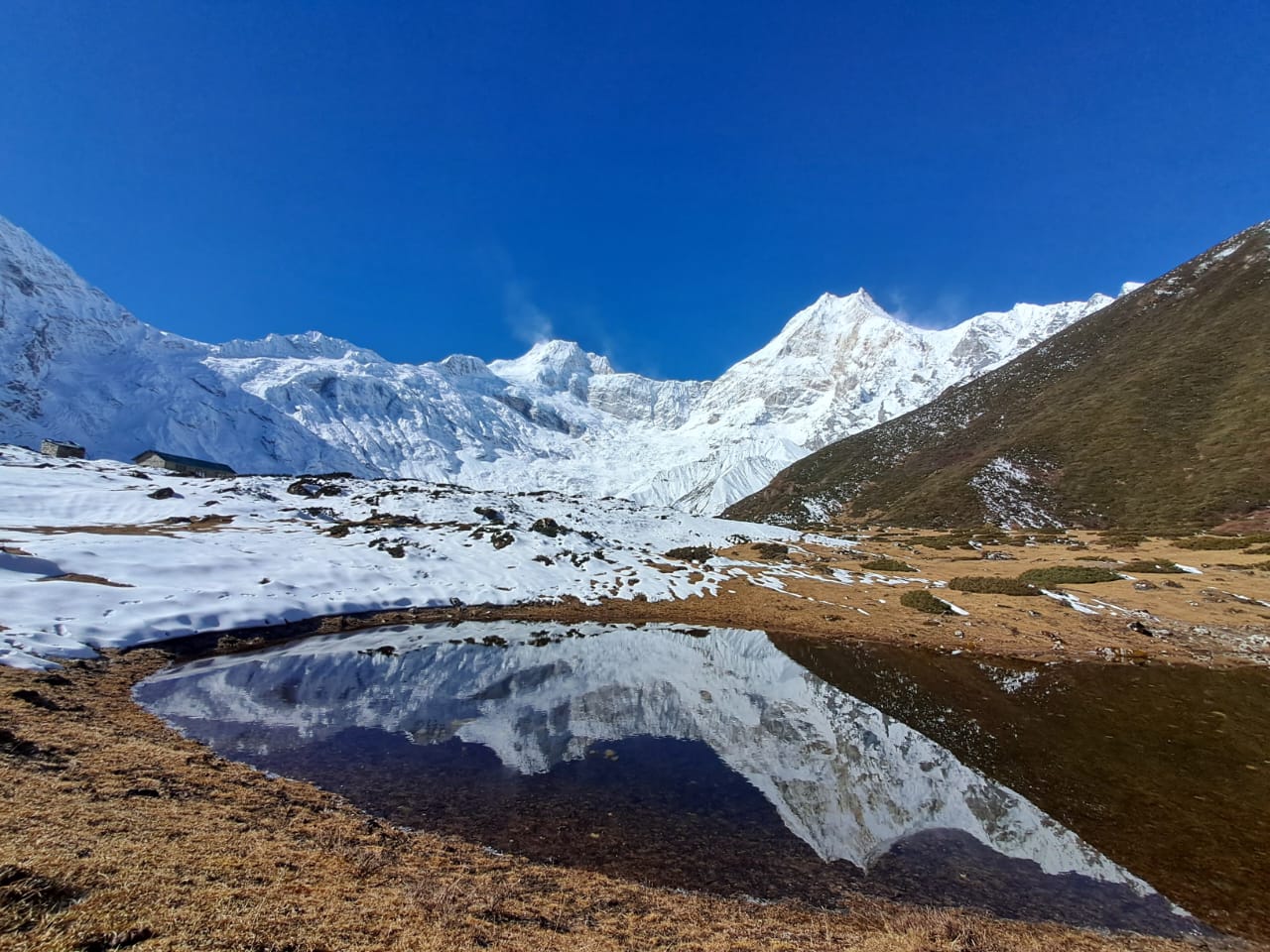
The passage itself is the toughest day. The start is early, typically in the chilly cold when you can feel even the crunching of ice frozen on grass under your boot. The climb, it is steady but long, and the air feels thin enough to remind you of every single step, but when you finally reach the summit, surrounded by solitude, there you’ll experience a strange mix of exhaustion and calm; it’s like the mountains are acknowledging your effort.
What makes Manaslu Circuit Trek truly challenging isn’t about altitude, or distance-it’s the remoteness. Compared to more commercial facilities, trekking facilities are basic, and you can’t always rely on comfort. But that’s also its charm. It feels raw, real and deeply immersive.
In the end, the Manaslu Circuit Trek isn’t about providing something. It is about enduring, adapting and quietly pushing forward. And somewhere along those long trails, you realise that the difficulty is exactly what makes it unforgettable.
Highlights of the trek
- Endurance over Athletics: The challenge of Manaslu isn’t about technical climbing of ropes; it’s about steady stamina and your ability to remain consistent through long, high-altitude days.
- The Larkya La Threshold: At 5,106 meters, the Larkya La Pass is the Trek’s ultimate defining moment, requiring a patient, slow-burning approach to conquer the thin air and steep descent.
- The Luxury of Solitude: Unlike other popular busy trails, Manaslu offers a raw and quieter experience, meaning you trade modern resort comforts for authentic Himalayan stillness and rustic teahouse charm.
- Preparedness is power: The most successful trekkers aren’t necessarily the fastest, but those who arrive with pre-conditioned legs and a mindset ready for the rhythm of the mountains.
- A psychological Journey: Beyond the physical climb, this circuit demands mental resilience; your attitude and patience often matter more than your lung capacity when the trail gets tough.
The seasonal window (When to go)
Autumn (September to November): This is the gold standard of the Manaslu circuit. Following the monsoon, the dust has settled, the air is crystal clear, and the views of the 8,163m peaks are consistently sharp.
Spring (March to May): A favourite for nature lovers, while the high passes may still have a lingering snow, the lower forest comes alive with blooming rhododendrons, and temperatures are slightly warmer during the day
The restricted area status (why you need a guide). Manaslu is a sensitive border region. Unlike the Everest or Annapurna regions. The Nepalese government classifies this as a restricted area. This means:
You cannot trek solo; a minimum of two trekkers is required.
A government-licensed guide is mandatory for the entire duration.
Permits must be processed through the Registered Trekking Agency in Kathmandu.
The elements of challenge during the Manaslu Circuit Trek
The ascent into the thinner Air: Instead of a simple hike, think of this as a slow-motion climb into the clouds. The steady gain in altitude requires your body to adapt daily to decreasing oxygen, making even the simplest steps feel more significant.
The 5,000m milestone: The peak journey is conquering the Larkya La Pass. Sitting at 5,106m, this high-altitude gateway demands your full focus and physical resolve, serving as a high-altitude test of your endurance.
A journey into the unplugged wild: Manaslu is a step away from the modern world. The infrastructure here is raw and rustic, trading city comforts for basic mountain shelters and a rare, ‘’off-the-grid’’ atmosphere that challenges your mental adaptability.
The test of Daily Momentum: This is a Marathon, not a sprint. Success on this trail comes from your ability to sustain 6-8 hours of movement day after day, managing your energy as the cumulative fatigue of the journey begins to build.
A dynamic and ever-changing Path: The trail is a living thing. From the humid riverbanks of the lower gorge to the wind-scoured scree slopes near the pass, the terrain is constantly shifting, requiring stable footing and a focused pace.
The Elevation factor
This trek takes in an elevation beyond the range where levels of oxygen drop significantly, and even breathing becomes a tough task. Our itinerary takes us through variations of elevations, eventually taking us beyond 5,000m, an elevation so high that you can see and feel clouds around you, which indicates a significant elevation gain and exposure to the risk of altitude sickness, which begins at 2,500m.
Which is why we’ll be following the scheduled pattern of acclimatisation strictly at different points. One of them is Samagaon(3,530m), and the other is at Samdo, which is an additional point for rest.
It’s wise and important to undertake the days for acclimatisation in order to help the body adapt and recover well.
Whenever altitude sickness occurs, various symptoms can show up as follows:
- Nausea
- Vomiting
- Fatigue
- Insomnia
- Loss of appetite
- Weakness
Besides the signs mentioned above, the conditions as follows are also very common and life-threatening.
- HAPE-High Altitude Pulmonary Oedema: Accumulation of fluid in the lungs leading to breathlessness.
- HACE-High Altitude Cerebral Oedema: Rise in Intracranial Pressure from fluid build-up in the brain, leading to disorientation and confusion.
To avoid/deal with it, you must follow measures, such as:
- Rest
- Gentle descending.
- Warm fluids intake
- Steady pace
- Proper acclimatisation.
It’s recommended to have proper insurance that covers your medical expenses, along with the cost of an emergency helicopter evacuation to rescue you if conditions worsen.
Daily walking hours
You’ll be on your feet for around 6-8 hours on average on normal days and 8-9 hours while crossing the pass, and this is one of the major reasons you should come well prepared, with proper exercise and training to help yourself with the challenging terrains of the trail.
Oftentimes, first-timers in Nepal end up exhausted, not knowing how to maintain pace in ups and downs.
It’s important to maintain a steady pace as it helps in conserving energy and keeps moving consistently in the long run, which is key to a successful trek.
The trekking trails and terrains
The overall difficulty, pace and nature of the trek depend on the condition of the trail. The trail feels and is more of an uneven and uncertain path rather than a technical one.
When in lower regions and valleys, the trail often rises and drops frequently, reminding your legs of the trail’s pattern. Expect to see the following.
Exposed ledge walks
While structurally secured, certain segments on the trail hug the mountain’s edge, creating a sense of height. These passages require extra focus and a steady foot, particularly when yields are necessary for oncoming mule caravans.
Aerated Suspension Bridges
These crossings are engineered for stability but span a significant height over churning river gorges. The subtle sway and vibrations of the bridge- particularly during a gust of wind- can be a thrilling yet bone-chilling experience for first-timers to the Himalayas.
Rugged unpaved footing:
The path is rarely level. You’ll spend much of your time navigating a mosaic of loose scree, fractured rocks and natural path, requiring boots with excellent ankle support and reliable traction.
Active erosion zones:
Primarily situated between Machha Khola and Jagat, the stretches are sensitive to the elements. While easily crossed in clear conditions, they become significantly more technical and slick post-rainfall.
Health and Fitness requirements
To do this trek, you need to have a healthy body and the ability to consistently walk for 6-8 hours. Someday it’s shorter, and other days it might be longer. It isn’t particularly challenging on daily ascents, but more of an accumulation of collective effort and strain on your body, which requires and can be handled by a steady pace, which can be gained by good cardio condition, along with good endurance power of legs and backs and lungs.
We’re not on a fast-paced walk or race; it’s a long walk, so a slow and steady pace is to be maintained whether it’s uphill, downhill or on the plains.
- Activities like regular walking (uphills and climbing stairs)
- Rock climbing practises
- Squats, lunges and swimming can help improve the agility of muscles, improve bone density and lung capacity, along with breath control.
- Endurance and consistency are the thing that matters more than raw strength to sustain and survive the challenge.
Where the Trail starts easy- and slowly changes
The early days of the Manaslu Circuit Trek feel surprisingly gentle, with villages, greenery, and the steady sound of the river beside you. It almost tricks you into thinking that Trek will stay this way. But slowly, the client gets longer, the path gets rougher, and comfort fades. You don’t notice the shift in one moment-it happens gradually. And before you realise it, the trek has become something much more demanding.
The rhythm of constant ups and downs
There is no such thing as a flat day on this trail. You are either climbing steep, stone steps or dropping down into the river valleys, only to climb again. There is no such thing as a flat day on this trail. You are either climbing steep, strong steps or dropping down into the river valleys, only to climb again.
It creates a rhythm that your body has to adapt to, whether it likes it or not. Some days feel repetitive, but that reputation is exactly what wears you down. It’s not one big challenge-it’s hundreds of small ones stacked together.
When the altitude starts to speak
As you move higher, your body starts sending quiet signals: slower breathing, slight headaches, a need to pause more often. It’s not often dramatic at first, but it’s constant. Villages like Samagaon and Samdo bring you into thinner air where every step feels heavier.
You begin to understand that this trek isn’t just about working, but about listening to your body and respecting the altitude.
Crossing Larkya La: The Longest Day
Crossing Larkya La pass is the kind of day you think about long before it arrives. It usually starts early in the cold with a steady climb that seems to stretch forever. The altitude makes every step feel slower, more deliberate.
But reaching the top brings a strange, kind of quiet-not loud excitement, just a deep sense of having made it through. It’s less about conquering the past and more about enduring it.
Psychological resilience and seclusion
One of the hardest parts of the Manaslu Circuit Trek isn’t obvious at first.
The beginning of the trek doesn’t always show you what’s yet to come. The hardest parts aren’t always visible, but as you progress, you’ll uncover the remoteness.
Villages are farther apart, the facilities are simpler, and there’s less room for comfort. You can’t rely on the same ease you might find in the busier trekking regions. On this land above 4,000m, as someone from cities with constant auditory exposures of the hustle and bustle of town, the solitude and silence might feel too loud.
A place so secluded and with no touch of the modern world, standard and constant social media noise, it makes your system detoxified in a way. And if you’re someone who has been used to the modern distraction, then the solitude can be too loud and mentally tiring.
And over time, that isolation becomes its own kind of challenge, but it’s also what makes the experience feel genuine.
Accommodation, the teahouse experience
If you are a first-time trekker to Nepal, do not have high expectations and standards during the trek, because it’s a mountain. If you’re expecting high-end facilities and comfort in such mountains, then you might wanna reconsider because getting to breathe well after you cross the threshold for altitude sickness is the comfort here.
The facilities and amenities won’t be high-end, rather basic, but a warm and welcoming one full of hospitality, run by local families to provide basic warmth and comfort at the bone-chilling elevation.
Even if not the high-end facilities, you can expect the decent facilities and services as follows:
Twin-sharing lodges: you’ll stay in modest, dual-occupancy rooms furnished with handcrafted wooden frames and functional mattresses. While simple, these rooms provide a dedicated space for rest after a long day on the trail.
Communal washroom: Sanitation facilities are generally shared-access and often in a publicly accessible point (outside the main lodge). These no-frills washrooms focus on utility and are kept separate to maintain hygiene in the living quarters.
Off-grid Bathing options: Hot water is a luxury in the high mountains. Depending on the elevation, you may have access to solar-tempered water or a traditional bucket bath, where heated water is provided for a small additional fee.
Centralised warmth: To conserve energy, the sleeping quarters remain unheated. Instead, the focal point of the edge, i.e., the communal dining hall, where a central cook or yak-dung stove provides cosy, heated air for the evening meal and socialising.
In the lower villages, amenities are reasonably comfortable. But once you rise beyond 3,500m to places like Dharamsala or Samdo, things start to get more basic. Food options shrink to whatever can be transported on the trail. Fresh items too get rarer. Porters or mules carry in every sack of rice,
gas cylinder, or a bottle of water, leading to a price spike.
Food and Drinks
It’s a high altitude, a point where even the oxygen is so scarce to breathe, makes the supply and logistics much more difficult. Showing a wide selection of food and drinks is impossible because of the hostile environment. This makes it extremely difficult to ship supplies here, and in such conditions, even getting the necessities for survival is an optimum service.
Hence, the most popular cuisine in the area is a conventional Nepali dish consisting of rice, lentil soup, Vegetables, salads and Pickles.
Over time, locals have started offering a wide variety of products, including some Western and Asian cuisines. You may get some delectable fruits like stir-fried rice, soft flat breads, hot soup and Muesli. They are somewhat pricey. You will get simple hot drinks like tea, coffee and hot lemon. Those things might sound basic. But to get those things in there is a luxury at those altitudes.
Tips for beginners
Prioritise RPE (rate of perceived exertion). Do not try to keep up with the fastest person in the group. Your goal is to maintain the pace where you can still hold a conversation without gasping for air. If you’re too breathless to speak, you are moving too fast for the altitude.
Condition your feet, not just your lungs: Physical fitness is great, but “trail-hardened” feet are more important. Wear your trekking boots on long walks on the stair sessions for at least 2 months before your departure to eliminate hot spots and prevent blisters.
Master the art of layering. The temperature shifts dramatically as soon as you stop walking. Keep a “Summit grade” down jacket at the top of your day pack so you can throw it on immediately during the rest breaks to prevent your body temperature from Plummeting.
Hydrate with intent: Altitude dehydrates you faster than you realise. Aim for 3 to 4 litres of water daily, and consider using electrolyte tablets to maintain your mineral balance, which helps prevent fatigue and minor headaches.
The “Mountain-side” Safety rule: Whenever you encounter a mule caravan or yaks on a narrow trail, always move to the side of the path closest to the mountain. Walk near the cliff edge to avoid being accidentally nudged.
Invest in high-quality trekking poles: For beginners, poles aren’t optional. They act as a second set of legs, absorbing of 25% of the impact on the knees during this long, steep descent from the Larkya la Pass.
For your backpack
And now let’s talk about the packing list. For anyone travelling here for the first time. You need to know what to pack and not, to avoid extra weight and to have a comfortable, safe travel by dealing with the environmental factors based on the time of your travel.
- Altitude sickness medicine/Diamox.
- Ibuprofen or paracetamol.
- Oximeters.
- First aid kits.
- Oral rehydration salts or anti-diarrheals.
- Flip flops.
- Daily medicine (Personal medication)
- Toiletries (Wipes/Sanitisers)
- Multipurpose Toolkit.
- Well-rated gloves and footwear.
- Chargers and a power bank ( As cold weather might affect the batteries)
Important medical advice.
- Hydrates frequently at altitude; dehydration is dangerous.
- Rest if symptoms of AMS start to show up and do not push further, acclimatisation is the key to good health, not motivation.
- Avoid intoxicants like smoking and alcohol as it dehydrates and worsen the conditions.
- If you are a recent patient of some surgery or a sensitive treatment. Please do consults to your doctor before starting the trek.
Conclusion/wrap up
The Manaslu Circuit Trek doesn’t try to impress you right away. It doesn’t overwhelm you with crowds or constant highlights. Instead, it feels quiet through long days, changing landscape, and that steady feeling of effort that never really leaves.
And maybe that’s what makes it different.
By the time you finish, it’s not just about crossing a high pass or covering distance. It’s about how the trail slowly shapes your pace, your thoughts, even your patience. The difficulty doesn’t come from one moment- it comes from everything adding up.
And somewhere along the way, you realise that the silence, that remoteness and the challenge were never separate things. They were the whole point.
FAQ
Who is at the highest elevation on this trip?
The highest point on this trip is Larkya La Pass, which sits at an elevation of 5106 meters, 16,752 feet.
How many days does the standard Manaslu Circuit take?
Most trekkers complete the circuit in 12 to 14 days, though an 18-day itinerary is recommended for proper acclimatisation.
Is the Manaslu circuit more difficult than the Annapurna circuit?
It is considered more challenging due to its remote nature, rougher trail conditions and steeper daily ascents.
Can I trek the Manaslu Circuit Solo?
No. Government regulations require a minimum of 2 trekkers and a licensed guide to obtain the necessary restricted area permit.
What permits are mandatory for this trek in 2026?
You must have a Manaslu restricted area permit (RAP), the Manaslu conservation area permit (MCAP), and the Annapurna conservation area permit (ACAP).
Can I trek the Manaslu Circuit solo?
No, government regulations require a minimum of two trekkers and a licensed guide to obtain the necessary Restricted Area Permit.
Is there a risk of altitude sickness on this route?
Yes, since you spent several days above 3500 meters, taking mandatory acclimatisation days in the villages like Samagaon is essential.