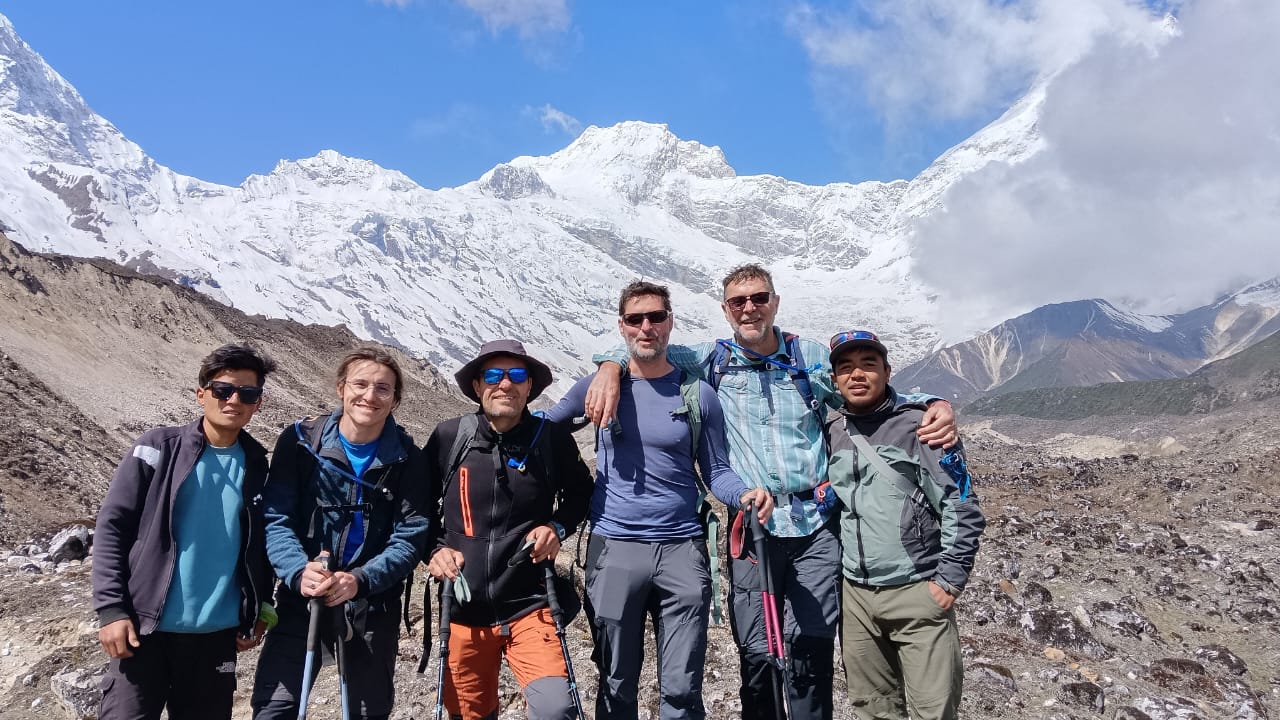
Manslu circuit trek, a dramatic trek in itself, why? Because it’s a slow buildup of the anticipation, something that doesn’t happen to you right away with the swift excitement or make you cheer up, but unfolds like layer after layer, until the time you realise you’re standing in the middle of nowhere, surrounded by mountains that feel too big to belong to this world. You realise this trek was never meant to be rushed.
And that’s exactly why timing matters so much here.
Unlike many other trading routes in Nepal, the Manaslu Circuit is relatively raw, less commercialised and more sensitive to seasonal changes. The same trail can feel like a dream in one month and a survival test in another. Choosing the best time to trek Manaslu isn’t just about weather; it’s about shaping the entire experience, from the landscapes you see to the challenges you face.
Most people aim for spring or autumn, and it’s for kinda good reason. But if you move deeper, each season offers a completely different version of the Himalayas. The question is not when the best time is, but rather what kind of journey you are looking for.
What to expect from the weather in Manaslu?
Anyways lets keep the flow going and talk about the weather, because that’s what matters the most when we think of planning the trip anywhere, isn’t it?
Personally, I would not wanna go to a place where it rains a lot or gets gloomy most of the time, cause it just kills the vibe and doesn’t feel like the proper use of time.
So it’s also important for you to know and understand at what time of the year and what kind of pattern the Manaslu region behaves in.
The trip goes from green fields to a harsh desert-like environment influenced by altitude. Like something you experience at 1,000m of elevation completely alters at 5,000m
If we are specific and point out places, particularly near the villages of Soti Khola and Jagat, the weather can feel warm and kinda humid or might even be slightly tropical, but when we start getting higher and higher, the air starts to get more cool, which is obvious. And by the time you almost reach the Larkya La Pass, the temperature will start to feel cold, and as for the winds, they feel no less than the wind on the ocean at night, chill as ice.
This variation is what makes the Manaslu Circuit really different, and it’s also the reason why choosing the best season is critical, as good weather just doesn’t improve views but determines your health, safety and overall enjoyment.
Spring (March-May)- Time that feels alive
Spring in here is surreal. Just surreal. As if you’re stepping into painting or something like a colour art brought to life.
The forests start to show signs of life following the departure of winter, and its silence, particularly the rhododendrons, appear as if they paint the entire trail, and to be honest, it does really feel that way, and to make it better, the flowers have colour variations red, pink, and white, which makes the land like a piece of heaven.
As for the air, it feels like it has some sorta energy in it, the village becomes more active, trekking routes start to get filled with movement again, and everything feels like it’s getting ready for a new season.
It’s a well-balanced moment, not crowded, not empty either.
Weather patterns and trail conditions.
The temperatures during the spring are generally moderate, making it comfortable for long trekking days. Lower elevations are warm during the day. High elevations remain particularly cool at night.
Early in March, the snow can still cover sections near Larkya La Pass, but by April and May, the trail gets more stable and easier to navigate as the snow will have melted away.
As for the afternoon? It can bring clouds sometimes, especially later in the season, but mornings are typically clear enough for the. Mountain Views. The key is starting early and making the most of those crisp, clear hours.
The experience of trekking in the spring
There is something deeply satisfying about trekking in spring, which is that it feels optimistic. You’re not battling extreme cold or constant rain. Instead, you’re walking through changing landscapes, watching the Himalayan transition from winter to summer.
For many trekkers, this season strikes the perfect balance between comfort and adventure.
Autumn season, September to November
Why is autumn considered the best time?
Autumn is hard to beat when it comes to the reliability of the weather conditions. Due to the fact that it begins after the end of winter, which means the clouds and fogs are all cleared, the sky is bright and crisp. And it’s neither too hot nor too cold. It is one of the best seasons due to the comfort, because you can trek in shorts or even in jumpers. You can adjust as per your preference and comfort.
And apart from that, the views are clear, sharper and closer, and almost look unreal in their clarity.
This is when the Manaslu circuit looks its absolute best.
Weather, stability and visibility
Just like previously I described.
Autumn offers stable weather with minimal rainfall and low chances of snow at higher elevations. At least until late November.
Daytime temperatures are comfortable for trekking, while nights become progressively colder as you gain altitude.
And if we are talking about visibility, then during this season it is exceptional. You’re not guessing where the mountains are, because you’re seeing them in the full glory, often from sunrise to sunset.
The trade-off: popularity
Yes, Autumn is the busiest trekking season in the world. But here’s the interesting part, the Manaslu Circuit still doesn’t feel overcrowded compared to other regions like the Everest or Annapurna routes. You will see other trekkers share tea houses and exchange storage, but you won’t feel overwhelmed. Mark my words.
The Overall experience.
Let’s talk about the experience. How it feels.
It feels almost effortless compared to other seasons. The trails are dry, and the skies are clear, and everything seems to work in your fever. If you want the highest chance of a successful and usually rewarding trek, this is your moment to click for.
Winter season (December to February)- The silent challenge.
A different kind of beauty.
Winter transforms the Manaslu Circuit into something entirely different. The trail becomes quieter, the village less active, and the landscapes more dramatic. The snow covers higher sections, and the entire region feels still, almost frozen in time.
There’s a kind of beauty in here that’s hard to describe, Minimal, raw and deeply Peaceful.
The reality of trekking in winter.
Now let’s be real. Let’s not make too much of a fantasy out of it. Winter trekking here is tough. Temperatures can drop below the freezing point. Especially at night. Water source freeze tea houses may close, and crossing the Larkya La Pass becomes significantly more challenging due to snow and ice.
This isn’t the best season for casual trekkers.
Who should consider winter?
If you are experienced, well prepared and looking for solitude, winter can be incredibly rewarding. You will have the trail almost entirely by yourself, and the sense of isolation adds depth to the experience.
Monsoon season (June to August) chaos and green beauty.
The challenges you can’t ignore.
Monsoon is easily the most difficult time to trek the Manaslu circuit. Heavy rainfall makes pale, muddy and slippery landslides a real concern, and leeches become your unwanted travel companions.
Visibility is also limited, with clouds often hiding the mountain completely.
The unexpected upside.
And yet there’s something so uniquely beautiful about this season. The forest turns incredibly lush, waterfalls appear everywhere, and the landscapes feel wild and alive. It’s messy, unpredictable, but undeniably vibrant.
Who this season is for.
Monsoon is for a very specific type of traveller, someone who values solitude over comfort and doesn’t mind a bit or a lot of unpredictability. For almost all people, though, this season is best avoided.
Month-by-month breakdown of the best time.
The month of March offers a quieter start to the trekking season with lingering winter elements. Capital is arguably one of the best months, combined with stable weather and blooming landscapes, which may bring warmer temperatures and clearer high altitude conditions.
Speaking further, the month of September marks the transition from monsoon as the visibility improves with occasional downpour And for the month of In October, it stands out as one of the ideal. Because the weather is stable. The skies are clear, and the trekking conditions on the trail.
November offers crisp air and fewer crowds, though temperatures begin to drop a bit.
Crossing Larkya La Pass- Timing is everything.
Larkya La Pass is the highest and most demanding part of the trek. Which sits over an elevation of around 5,100 meters.
Crossing isn’t just about fitness; it is more about timing. In spring and autumn, the pass is usually stable with manageable snow and clear routes.
As for the winter, the snow is heavy, which ultimately makes it dangerous or even impossible.
During the monsoon, whether unpredictability. Add another layer to this. This is why most successful treks are carefully planned around favourable seasons.
Choosing the best time based on your travel style
Let’s be straightforward and clear-cut to the point.
People have busy lives, and not everybody has the same time for vacation in order to travel to a specific place. Sometimes what really happens is. If the highlight is during April and your vacation starts from there. June, then the highlight is gone, so it is one of the major reasons for that. You need to be specific regarding your time and your travelling style.
If you want. Perfect views and minimal risk, autumn is your best bet. If you prefer fewer crowds in vibrant landscapes, spring offers a much more personal experience.
Winter is for those who seek solitude and don’t mind harsh conditions.
Monsoon is challenging, offers a raw and unique perspective of the region.
So every season has its ups and downs. It just depends on you, how you manage and at what time of the year you prefer to travel.
Your choice should reflect not just your schedule, but your personality as a traveller.
Important permits for the Manaslu Circuit Trek.
The Manaslu region is a restricted trekking area declared by the government due to the border subjects and their legalities. Which is why trekkers must obtain the following permits.
- Manaslu Restricted Area Permit (RAP).
- Manaslu Conservation Area Project Permit (MCAP).
- Annapurna Conservation Area Permit.
Additionally:
- Trekking must be arranged through a licensed Trekking agency.
- A registered guide is mandatory.
Tips for high altitude
So we will be around the elevations of 5,000 meters during this trip, which is way higher than the regular standard elevation of 2,500 meters. After crossing it, Attitude sickness usually kicks in, not always, but this is the typical threshold after crossing, at which the symptoms might appear.
So here’s what you should do.
- Acclimatise properly.
- Walk at a steady pace.
- Stay hydrated.
- Carry medicine with you all the time.
- Get yourself fit with proper cardio and fitness exercise before the trek, and as soon as you start to feel uneasy and detect the symptoms of AMS, inform your guide or companion.
Final thoughts
The Manaslu circuit trek is between the destinations. It’s about experiencing a journey that changes over time. The same trail can feel welcoming, harsh, vibrant or silent depending on when you walk on it.
And maybe that’s the real beauty of it.
There is no single best time that fits everyone. There’s only the time that aligns with the kind of experience we want. So choose wisely, because on this trek, the season doesn’t just shape the landscape, it shapes your entire story.
FAQ’s
How hard is this trek?
Honestly, it’s a total beast compared to Annapurna, so come prepared.
Do I need a guide?
Yeah, you basically have no choice, solo trekking his banned here.
Is the food any good?
It’s mostly dal bhat, which is fine until you have had it 10 days straight.
When’s the best time to go?
Go in October. The views are wild, but the trails get pretty crowded.
Is there Wi-fi?
Don’t count on it. It’s sketchy at best and expensive when it actually works.
Can I charge my phone?
You can. Most places will charge you a few bucks for the favour.
How’s the altitude?
It’s no joke, so seriously, don’t skip those acclimatisation days.
What is the highest point?
You will hit Larkya La Pass at over 5,100 meters; it’s brutal.
Is the water safe?
Not straight from the tap, use tablets or a filter unless you want a stomach mess.
What should I pack?
A solid down jacket is a must because the nights are soul-crushingly cold.
Are there ATMs?
Basically, none once you start. So carry all the cash you think you will need.
How long does it take?
Most people will spend about two weeks on the trail, give or take a day.
Is it dangerous?
Just watch out for rock falls and the yaks; they basically own the trail.
Do I need a permit?
You need three different ones, and your guide usually handles that headache.
Is it worth the effort?
100%, the views at the top are just absolutely mind-blowing.