Overview Let’s dive into the world of glaciers and the icy path of the Langtang valley, do some cultural and geographical exploration, taste some flavours, and get to know the […]
Duration: 6 Days
Best Time:
Trip Grade: moderate
Start from Kathmandu and End to Kathmandu
Min 2 to Max 10 Pax in a group
Meals: Breakfast, Lunch, Dinner
Accommodation: Tea House
Overview
Let’s dive into the world of glaciers and the icy path of the Langtang valley, do some cultural and geographical exploration, taste some flavours, and get to know the Himalayan nation of Nepal a bit better.
A journey, masterclass in itself in Himalayan contrast, taking you from the humid, green bamboo forests to the lower elevating trails to the high-alpine sanctuary of the Langtang Lirung massif.
It’s also called the “Valley of Glaciers”; the structures look like something nature itself carved out with its expertise in architecture.
A place where the frozen world just doesn’t sit frozen on the horizon, but when you look over your shoulders, it will appear as if it’s right above your shoulders. It’ll feel unreal, believe me.
Besides those nature masterclasses, culture is something that is there to witness for you, and the Tamang Heritage, passing ancient Mani Walls and prayer flags, isn’t just some cultural property but also more of an entity that represents the endurance, strength, and patience of the people.
A place where nature and traditions collide and fuse to create and keep life functioning. By the time you reach the Kyanjin Gompa, you’ll realise what life was, what life truly is, and what life we’ve come to live.
And when you ultimately look from the aerial perspective, a different dimension to our world, you’ll feel what really matters in life, and how much we overthink, and what we should do to live life.
Highlight: The Langtang profile.
The valley of Glaciers
Let me tell you something, we’ve talked about this in the introductory part too, haven’t we?
Langtang is not just a valley made of soil and stone. It’s more than that, better to say a fusion, a fusion of geography, culture, and traditions, but most importantly, the part that still makes it stand out is the glacier that it has; these are some of the most accessible glaciers in the world.
Which means on this trek we’ll take a walk through the glacier, it’s deep, and is surrounded by alpine pastures where yaks graze.
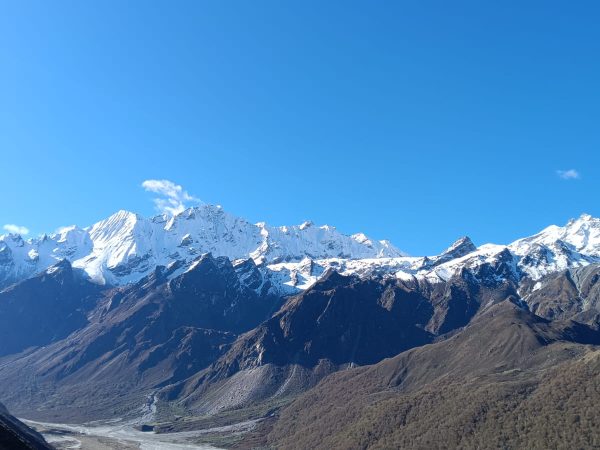
On other treks, you see the mountains, but you don’t walk in there; here, you’ll be literally walking on the feet of the Langtang Lirung (7,227m), which feels like it’s watching directly over your teahouse, as if it’s saying “hey buddy”.
Kyanjin Gompa & The Cheese Factory
Now, let’s talk about culture highlights, the Kyanjin Gompa. A 700-year old Buddhist monastery sitting at 3,870m. That’s longer than the history of not just countries but some of the continents in the world.
Just imagine, a symbol of culture that’s standing there representing the history of time, even though the world has moved ahead, that’s fascinating, isn’t it?
As for the taste of local produce, there’s a cheese factory, a Swiss cheese factory, producing Swiss-style yak cheese, a taste of freshness, locality, and lifestyle while you look at the 7,000m peaks.
It’s the ultimate reward for the trip.
Tamang Heritage and Resilience
The valley tells a story of incredible strength. Largely rebuilt after the 2015 earthquake, this new settlement is a testament and symbol of consistency, faith, rebuilding, and endurance, and besides that, it’s also a visual representation of the cultural blend of Nepali and Tibetan traditions.
You’ll walk past Mani walls (prayer-engraved stones) and through villages where the hospitality is as deep as the gorges, and you’ll feel at home. Every smile you see here feels earned and authentic.
The Kyanjin Ri viewpoint
For the tactical highground, we scale Kyanjin Ri (4,773m). From this summit, you get a 360-degree panoramic view that includes Langtang Lirung, Dorje lakpa and even Shisapangma across the border in Tibet.
It is the highest point of the journey and provides the perfect visual summary of the valley before your aerial extraction.
Standing here, you realise why this is called the hidden gem of the Himalayas.
The Kathmandu Skylink.
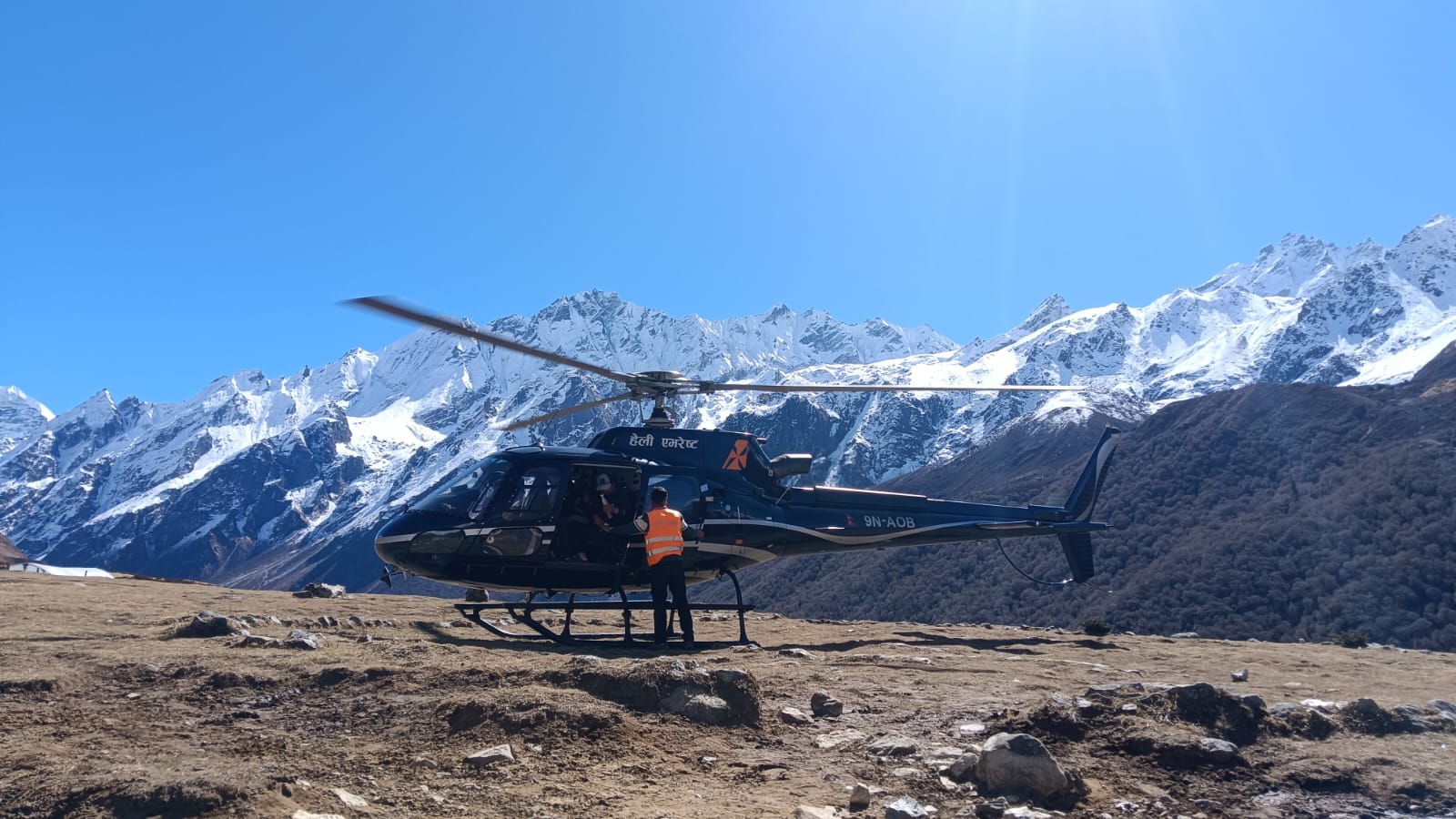
The Heli return from Langtang is one of the most efficient shortcuts in aviation. Instead of a ggruelling 2-daydescent and a bumpy 8-hour jeep. Right back to the city. You board the helicopter at Kyanjin Gompa and soar over the Gosaikunda Lakes and Langtang National Park.
In just 30 minutes, you transition from a silent, frozen, high-altitude world to the bustling history spokesman. It’s the ultimate way down without the physical cost.
Best time
Speaking of the best time for this trip, let’s explore the time of the year. We have champions standing toe-to-toe.
Autumn ( September to November)
This season right here is the undisputed favourite for anyone who wants the high-definition Himalayan experience. After the monsoon, the rain had scrubbed the atmosphere clean. The dust and haze are gone, leaving the air perfectly transparent. When you stand at the Kyanjin Ri in October, the peaks don’t just look big, they look sharp, as if the horizon is a high pixel reality.
And as for the Heli return, this is the most tactical choice as a stable, blue sky morning provides the smoothest flight conditions and the most cinematic aerial views of the glaciers.
Spring (March to May): The “Floral Contrast” Window.
So, like I said before, these two seasons stand toe to toe with each other, both of them being crystal clear seasons and very good for the trip. The only difference is the time when Earth sheds its skin at one and puts it back on at another.
Autumn was the time for shedding, so the earth could put on a new coat in spring. These two complete each other, which is why, despite their differences, these two are the best in 365 days.
The trail feels like a spectrum of vibrant colours, blooming flowers, green dense bamboo on the trail, and right above it, if you look above your head, there is the mountain watching you wearing its white, thick, snowy coat.
It’s beautiful, really beautiful, buddy, you’ve gotta give it a try at least once in life.
Itinerary
If you want tailor-made trip or want to personalize this itinerary, just feel free to contact us. We are always there to help you to make your holiday plan. Contact us
Day 01
Drive from Kathmandu to Syabrubesi (1,550m)
Altitude1,550m
AccommodationTea House
MealsBreakfast, Lunch, Dinner
It’s day one, and the trip officially began here. It’ll be a drive, a worthy one, full of new experiences because if you’re someone from lowland or coastal areas, basically from the place that not landlocked or in low altitudes than seeing hill is not everyday visuals, and roads there might be comparatively very smooth due to flatter lands, but Nepal, it’s different, roads are carved on cliffs, somewhere it’s bumpy, and somewhere to top it off with thrill it goes right by the edge of fast-flowing rivers high above the waters.
So basically, it’s a blend, a blend of excitement, adrenaline, serenity, and relaxation.
The bumps might cause a bit of “Ouch” feeling to your spines but that's not much of an issue to worry about, just a mountain thrill to your bones.
Of around 7 hours, the drive is worth every moment.
Day 02
Trek from Syabrubesi to Lama hotel (2,840m)
Altitude2,840m
AccommodationTea House
MealsBreakfast, Lunch, Dinner
So guys, we’re on day two of the trip, and today we’ll be going from Syabrubesi, our current location, to Lama Hotel. It was a drive yesterday, but today we’ll be starting the trek.
Once we cross the suspension bridge over the Bhoteskoshi, we leave the road world behind to enter the deep green territory of the Langtang National Park.
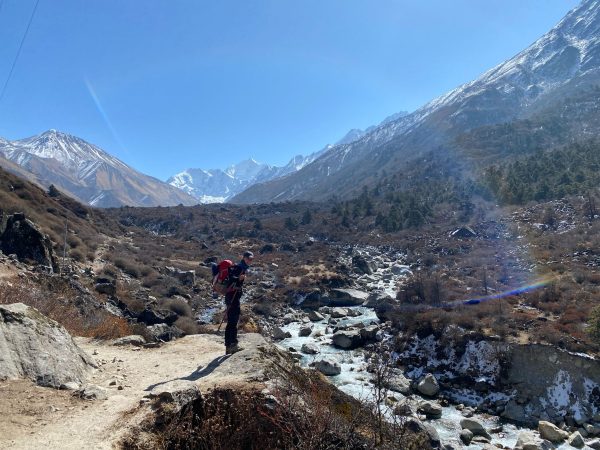
Today is all about the Langtang Khola. You won't just see the river, you will hear it the entire way, a constant roaring soundtrack that reminds you exactly where you are. The trail is a classic one, with ups and downs, and this isn’t even the start of the real walk, so I personally suggest you get your headphones or better get a good speaker to play some music on the trail, not loud to disturb the vicinity, but decent enough to keep the motivation going.
The trail will take you across dense subtropical forests of oak and maple. And if you keep your eyes on the canopy, you might spot a troop of langur monkeys watching us from above.
Around midday, we hit Bamboo 1970m. This is our first tactical race stop, where we will grab some fuel. From here, the gentle walking and the real climb starts. The trail kicks up towards Rimche, and this is where you feel the burn in your lungs as you gain about 500 meters of elevation in one go. It's a steep, rocky forest incline, but the shade of the trees and the mist from nearby waterfalls keep things cool.
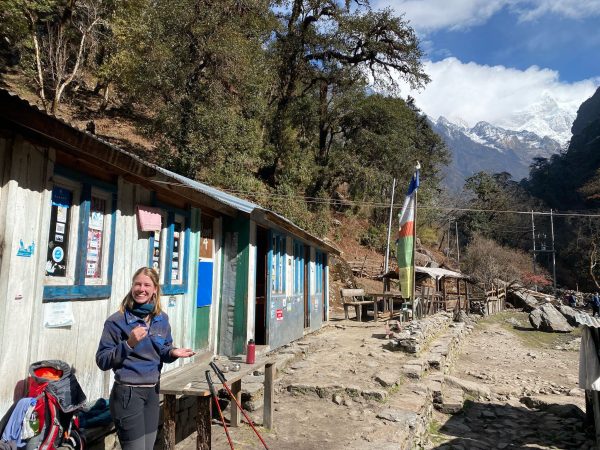
Finally, the forest starts to thin out just enough to reveal the Lama. hotel. And by the way, don't let the name fool you. It's not one big building, but a cosy cluster of tea houses tucked right into the heart of the forest.
And by the time we drop our bags, the temperature will have dipped. And the sound of the river will have turned peaceful. It's the perfect spot to settle in, grab a ginger tea, and realise that you are officially in the deep now.
Day 03
Trek from Lama Hotel to Langtang Village (3,430m)
Altitude3,430m
AccommodationTea House
MealsBreakfast, Lunch, Dinner
See? I told ya, it's going to have ups and downs.
And if you look at the elevation chart, then we have risen in altitude, and hence it's a breakthrough to the big views.
We will leave the humid mossy forest of Lama Hotel behind and start our push towards the open sky. The morning is a steady, shaded climb, but as we gain elevation, you will notice the trees changing from dense bamboo to pine and rhododendron.
The air gets cooler, and the light gets brighter. And you can feel the mountain energy starting to take over.
The tactical milestone of the day is Ghodatabela, 2,970 meters, which literally means the horse is stable. This is where the narrow gorge finally cracks open into a broad U-shaped glacial valley. It's usually here that you get your first massive HD look at the Langtang Lirung 7,227m.
We will stop for a small coffee break.
A cup of coffee in hand, sitting down under a chilling atmosphere while watching the blue glacial mountain and the clear sky. It will be fun. A once-in-a-lifetime experience, trust me.
After that, we will keep moving. And when you get to the Army checkpoint, the trail becomes much flatter but more exposed. We are now walking through Alpine meadows where yaks graze, and the wind carries the scent of juniper.
You will notice the Mani walls, a long row of stone carved with Buddhist prayers, which we always pass on the left. Following a local tradition, we respect the spiritual rhythm of the valley.
Day 04
Trek from Langtang Village to Kyanjin Gompa (3,870m)| A shorter day for acclimatisation.
Altitude3,870m
AccommodationTea House
MealsBreakfast, Lunch, Dinner
Today is a strategic day. A 3-hour push into the spiritual heart of the valley. As the trees disappear, you'll walk through wide Alpine pastures and past the region's longest Mani walls, with the massive icefalls of the Langtang Lirung hanging directly overhead.
It's a short, scenic transition into the glacial theatres that brings the scale of the Himalayas into sharp focus.
We will reach Kyanjin Gompa by lunchtime, allowing the body to adjust to the 3,870m altitude. The afternoon is reserved for a tactical visit to the legendary yak cheese factory. Where you can taste artisanal Swiss-style cheese. Made at the edge of the world between the ancient monastery and the grazing. It's a day of deep culture and recovery before we take the high ground tomorrow.
Day 05
Early morning hike to Kynjin Ri (4,773m) for the Panoramic views. Returning to the Gompa for the night.
Altitude4,773m
AccommodationTea House
MealsBreakfast, Lunch, Dinner
This right here is the peak of the mission.
So what will I be doing today? We will launch an early morning strike on Kynajin Ri, a steady climb. That tests our lungs but rewards us with the ultimate high definition panoramic view.
From the summit, you are surrounded by 360° walls of giants, including Langtang Lirung, Yala peak and even Shisapangma across the border in Tibet. Looking down at the glaciers you have spent days walking beside, you finally see the true scale of the Valley.
And yeah, after this summit victory, we will follow our way down with the rhythm descending back to the comfort of Kyanjin Gompa for a well-earned lunch.
Day 06
Kyanjin Gompa to Kathmandu on a flight
AccommodationHotel
MealsBreakfast
This is the moment you have been waiting for. Instead of spending the next three to four days retracing your steps through the dusty forest and a long, shaky Jeep ride. You will wake up to a silent, frozen morning in the sanctuary. As the sun hits its peak, your chopper arrives at the Kyanjin helipad, ready to tread the thin mountain air for the warmth of the valley in an elite 30-minute aerial transition.
The flight back is a visual masterpiece, up in the air, looking down at the massive glaciers and the sacred Gosaikunda lake from a bird's-eye perspective.
And with this, your Langtang Valley Trek has come to an end.
Inclusions
What's included
Accommodation
Important notes
Just like the other trekking trip, consisting of a heli tour, for the important notes, the details are almost similar.
Weight management
Helicopter extraction from Kyanjinn Gompa 3,870m is a high-precision manoeuvre that relies heavily on air density and aircraft agility.
At that altitude, the air is significantly thinner. Meaning there are fewer molecules for the engine to consume and the rotors to grab for lift. In the narrow corridor of the Lantern Valley Wind. Flows can channel between the steep mountain walls like a wind tunnel.
If the craft is overloaded, then its aerodynamics are compromised, making it difficult for the pilot tostabilisee the helicopter against these sudden crosswinds. This is why we enforce strict weight limits, typically for 100 to 500 KG per load. Staying within the tactical limit ensures the engine's maintenance of the power margin, allowing for the pilot to manoeuvre decisively through the gorge and reach the thicker, more oxygen-rich air of the lower Valley in record time.
The vertical Push
The ascent to Kynajin Ri (4,773m) Switch back, climb on the rugged Alpine rather than the stone steps. While ABC is known for its Stairway to Heaven. Langtang is a test of raw mountain trail endurance. You will be trading the thousands of stone steps for a steady high-altitude incline of dirt and rock as you push towards the high ground of Ri.
The Himalayan Breath
Helicopter extractions from Kyanjin Gompa typically target the 8:00 AM to 9:30 AM window to stay ahead of the wind tunnel effect. Because the Langtang valley is narrower than the Annapurna sanctuary, the wind picks up early and can channel through the mountains with high velocity. To ensure a smooth flight, we aim for calm, dense air in the early morning.
Tactical Acclimatization
Just like the rule for any other high altitude trip, we follow the same climb, high, sleep, low rule. Since this involves. The majority of trekking and just one day of a heli trip Which is why. We will use this strategy of high-ground pushes. Like the hike to Kynajin Ri followed by a return to the lower base for the night. Which signals our body to trigger a biological upgrade to naturally multiply red blood cells to transport oxygen more efficiently. Which helps us to maintain a steady, disciplined pace for the adjustment and calculated buildup of the endurance.
Hydration rule
In the mountains, your body is a high-performance engine running in a low-oxygen environment. You will be consuming 3 to 4 litres of water daily to maintain blood volume. And combat the dry effect of the high altitude air. For fuel, we will rely on the “Dal Bhat power” strategy, High carb slow burning mills that provide this steady glucose to your brain and muscles needed to produce and process oxygen efficiently. Proper fuelling is the difference between a successful aerial extraction and forced retreat.
Why take this trip?
You know, by now I have told almost a story for you to have a reason to do this trip, don’t you think?
Cause if you look, I have mentioned everything that you need to know, and let me tell you once again.
Not gonna use some fancy word. The places you’ll be visiting, but to be honest, a surreal one, the culture that gives you a feeling and experience of a time capsule. I mean, where in the accessible world would you find cultural practices of people that have still been able to maintain their authenticity, isn’t it?.
I'm not talking about some island concept that’s untouched and has not gone under influence. What I'm trying to tell is, the place has had visitors before, but the locals have never left the authenticity of their culture and practices feels like some rare piece of history, which is why I suggest you take this trip so you’ll get a chance to see and feel what it feel to be human still in touch with the earth again.
So the call is yours.
What's not included
Frequently Asked Questions
How high is the Kyanjin Gompa?
It’s at an altitude of 3,870m (12,700ft).
Is this trek harder than ABC?
It’s shorter and has a more gradual ascent, but it’s just as rewarding.
What's the best souvenir?
A block of legendary Kyanjin Yak cheese was the taste of the mountains.
Can we see Gosaikunda from Heli?
Yes, the flight path usually offers a stunning look at the sacred alpine lakes.
Can I charge my phone in Kyanjin Gompa?
Most teahouses have Solar power, but a portable power bank is your best tactical backup.
What permits do I need for the mission?
You will need the TIMS and Langtang National Park entry permit.
Is there a risk of altitude sickness?
We fly back from 3,870m to avoid the descent fatigue, but we trek slowly to ensure your acclimatisation is safe.
Will I have Wi-fi in the Valley?
Expect Digital Detox zones, though some tea houses offer paid Wifi that works when the sky is clear.
What should I wear for the Heli return?
Even if it is warm on the ground, the cabin and the high-altitude take off are freezing, so keep your down jacket handy.
Is solo trekking allowed in Langtang?
Current regulations require all trekkers to have a licensed guide for safety and navigation.